Global Liquid Lithium-Ion Battery Market to Reach USD 233.40 Billion by 2033, Fueled by EV Expansion and Grid-Scale Energy Storage
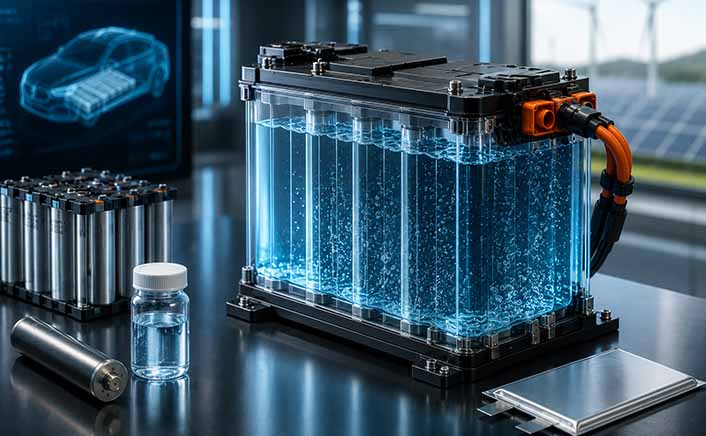
Rapid growth in electric vehicle production, battery manufacturing investments, and renewable energy integration is accelerating demand for liquid lithium-ion batteries worldwide.
The Global Liquid Lithium-Ion Battery Market is poised for significant expansion, with market revenue projected to increase from USD 68.70 Billion in 2025 to USD 233.40 Billion by 2033, registering a CAGR of 16.5% during the forecast period. Liquid lithium-ion batteries remain the preferred rechargeable energy storage technology due to their high energy density, long cycle life, fast charging capability, and broad adoption across electric vehicles (EVs), consumer electronics, industrial equipment, and stationary energy storage systems.
The rapid electrification of transportation continues to be the primary catalyst for market growth. According to the International Energy Agency (IEA), global electric vehicle sales exceeded 17 million units in 2024, accounting for more than one-fifth of new passenger vehicle sales worldwide. As governments strengthen carbon reduction policies and automakers accelerate EV production, demand for high-performance lithium-ion batteries continues to rise. At the same time, utility-scale battery storage projects are expanding rapidly to support renewable energy integration and enhance grid stability.
Manufacturing capacity is increasing at an unprecedented pace. According to BloombergNEF, global lithium-ion battery manufacturing capacity surpassed 3.1 TWh in 2024, with announced gigafactory projects expected to push installed capacity beyond 8 TWh by 2030. China remains the global leader in battery production, while the United States and Europe continue investing heavily in localized manufacturing through initiatives such as the U.S. Inflation Reduction Act (IRA) and the European Battery Alliance. India's Production Linked Incentive (PLI) Scheme for Advanced Chemistry Cells is also driving domestic battery manufacturing capacity.
The market is witnessing rapid technological advancements across battery chemistries. Lithium Iron Phosphate (LFP) batteries have become the leading chemistry for mass-market electric vehicles due to their improved safety profile, lower production cost, and longer operating life. Premium EV manufacturers continue adopting high-nickel NMC and NCA batteries for their superior energy density and driving range. Meanwhile, innovations such as silicon-rich anodes, cell-to-pack (CTP) architecture, fast-charging electrolytes, and advanced battery management systems are improving battery efficiency while reducing manufacturing costs.
Beyond transportation, energy storage systems (ESS) are emerging as one of the fastest-growing applications for liquid lithium-ion batteries. Increasing deployment of solar and wind power generation has accelerated investments in battery storage to improve grid reliability and energy flexibility. Governments and utilities worldwide are expanding large-scale battery storage installations to strengthen energy security and support renewable electricity generation, creating substantial opportunities for battery manufacturers.
Despite strong market fundamentals, the industry continues to face challenges related to raw material supply, critical mineral availability, and price volatility for lithium, nickel, and cobalt. Manufacturers are responding through long-term supply agreements, vertical integration strategies, and significant investments in battery recycling to recover valuable materials and reduce dependence on newly mined resources. Circular economy initiatives and recycling technologies are expected to play an increasingly important role in strengthening supply chain resilience.
Leading companies operating in the global liquid lithium-ion battery market include Contemporary Amperex Technology Co., Limited (CATL), BYD Company Ltd., LG Energy Solution Ltd., Panasonic Energy Co., Ltd., Samsung SDI Co., Ltd., SK On Co., Ltd., CALB Group Co., Ltd., Gotion High-Tech Co., Ltd., EVE Energy Co., Ltd., SVOLT Energy Technology Co., Ltd., Farasis Energy Inc., AESC Group Ltd., Toshiba Corporation, Amperex Technology Limited (ATL), and Sunwoda Electronic Co., Ltd. These companies continue investing in capacity expansion, advanced battery chemistries, strategic partnerships, and recycling technologies to strengthen their global market positions.
As governments intensify decarbonization efforts, renewable energy deployment accelerates, and electric mobility becomes mainstream, liquid lithium-ion batteries are expected to remain the backbone of the global energy transition. Continued investments in manufacturing, innovation, and localized supply chains will position the market for sustained long-term growth through 2033.